
Governance
**Update 5/14/2026**: The coalition has recently approved changes to the governance structure as we transition out of the Planning and Catalyst phases of the initiative towards a long-term operations phase of the CJF Southern Border Coalition. While the governance structure will be changing, the fundamental values and goals of the Southern Border Coalition will not.
The new governance structure will be led by a Coordinating Council that will provide strategic direction, ensure alignment across Coalition activities, and oversee implementation of the Regional Plan and Industry Activation Plans. This council will be composed of 17 representatives: Tradable Industry Working Group Chairs (6), Representatives from Coalition membership (4 - 2 from each county), K-16 Collaborative representative (1), Strong Workforce Partnership representative (1), Economic Development representatives (2 - 1 from each county), Public Policy representatives (2 - 1 from each county), SBC administration representative (1 - SDSU).
More information will be shared in the coming weeks regarding the selection process for Steering Committee representatives.
Historical Governance Structure
The Governance Structure of the Southern Border Coalition is centered on disinvested communities and impacted workers. The foundation of the inclusive planning effort is sharing information, and perspectives gathered through intentional and ongoing community and stakeholder engagement. Before the Regional and Subregional Task Groups take any action, drafts of these documents will be shared with the subregions for review and comment. Draft documents will be modified to reflect this input before the Regional and Subregional Task approve the document.
To best meet these planning objectives, the primary work of the Coalition shall be organized through two Subregional Task Groups, one representing Imperial County and one representing San Diego County. The Subregional Task Groups will come together to form the Regional Task Group.
Each of the subregional Sectors may hold separate planning meetings to share information and gather input to help inform the regional planning process, including providing input on draft documents and decisions before their approval by the Regional and Subregional Task Groups. Sector engagements and community meetings are two methods, but not the only methods, that will be used to learn about community priorities, vision, and needs. The Subregional Task Groups shall coordinate subregional sector meetings and may approve joint meetings of the sectors or the combining of the sector meetings to enhance, expedite, or facilitate the planning activities. Regional and Subregional Task Group and Sector meetings will be open to the public. Any community member who would like to participate in these forums who are not designated Coalition Members may do so in an informal capacity (i.e., will not participate in voting or other formalized capacities as outlined for Co-Conveners and Coalition Members).
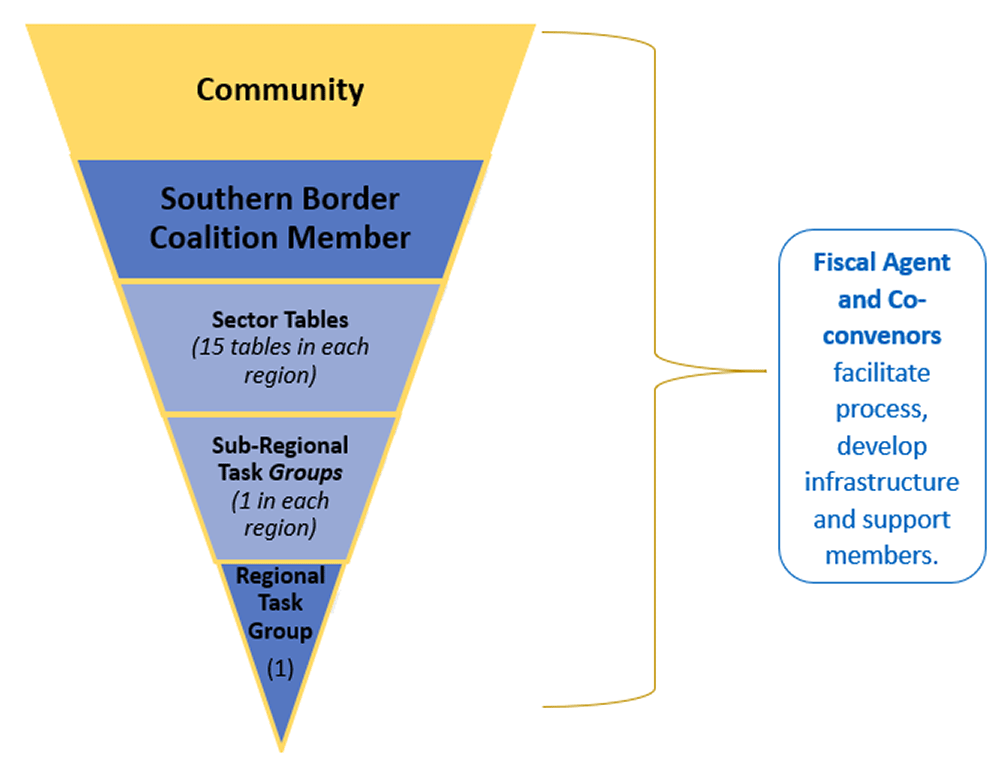
Southern Border Coalition Structure
- Community
- Southern Border Coalition Member
- Sector Tables (15 tables in each region)
- Sub-Regional Task Groups (1 in each region)
- Regional Task Group (1)
Fiscal Agent and Co-convenors facilitate the process, develop infrastructure, and support members.
 Open the image full screen.
The diagram shows a funnel structure. At the top is Community, followed by Southern Border Coalition Members. Below are Sector Tables with 15 tables in each region, then Sub-Regional Task Groups with one in each region, and finally a single Regional Task Group at the bottom.
A side note indicates that Fiscal Agents and Co-convenors facilitate the process, develop infrastructure, and support members.
Subregional Sector Leads
| Sector | No. of Sector Leads | |
|---|---|---|
| Imperial County | San Diego County | |
| Labor organizations | 2 | 2 |
| Employers, businesses, and business associations | 1 | 1 |
| Grassroots and community-based organizations, community organizers, and community members | 3 | 5 |
| Government Agencies | 1 | 2 |
| Economic development agencies | 1 | 2 |
| Philanthropic organizations | 1 | 1 |
| Education and Training Providers | 1 | 1 |
| Workforce Entities | 1 | 1 |
| Environmental Justice Organizations | 1 | 3 |
| Worker Centers | 1 | 1 |
| Disinvested Communities | 5 | 7 |
| CA Native American Tribes | 1 | 1 |
| Youth | 1 | 1 |
| LGBTQIA | 1 | 1 |
| Farmworkers | 1 | 1 |
| TOTAL | 22 | 30 |
